Home / Reviews / The Bone Temple
Reviews · Movie28 Years Later: The Bone Temple, Reviewed: Nia DaCosta Stuck the Landing
Better than the first. An audacious, weird, philosophically ambitious second chapter that earns its strangeness.
Let me start with the take that will upset some partisans, because it is still the right place to start: The Bone Temple is the better of the two films. That is not a dismissal of Danny Boyle's 28 Years Later, which I still admire enormously. Boyle's film was structurally and aesthetically one of the most ambitious zombie films in the genre's history, built around a coming-of-age fable that happened to take place inside an apocalypse. But ambition and lasting power are not quite the same thing. Nia DaCosta, taking over a duology that was always conceived as two parts, does something Boyle did not quite do. She makes the franchise about something larger than one boy's journey, and she makes that larger thing stick.
The first film had a clean emotional engine: a kid trying to save his mother. That is powerful enough to carry a movie, and Boyle carried it beautifully. The risk of a second film was obvious. Once the kid's quest is resolved, what holds the story together? DaCosta's answer is bracingly unsentimental: everybody else. The Bone Temple is not about one family. It is about everybody who is still alive, and what they have decided to believe in order to keep going. That widening of the lens changes the genre math completely. A zombie film about one family is a survival story. A zombie film about a whole scattered population trying to make meaning out of mass death is a philosophical story that happens to have zombies in it.
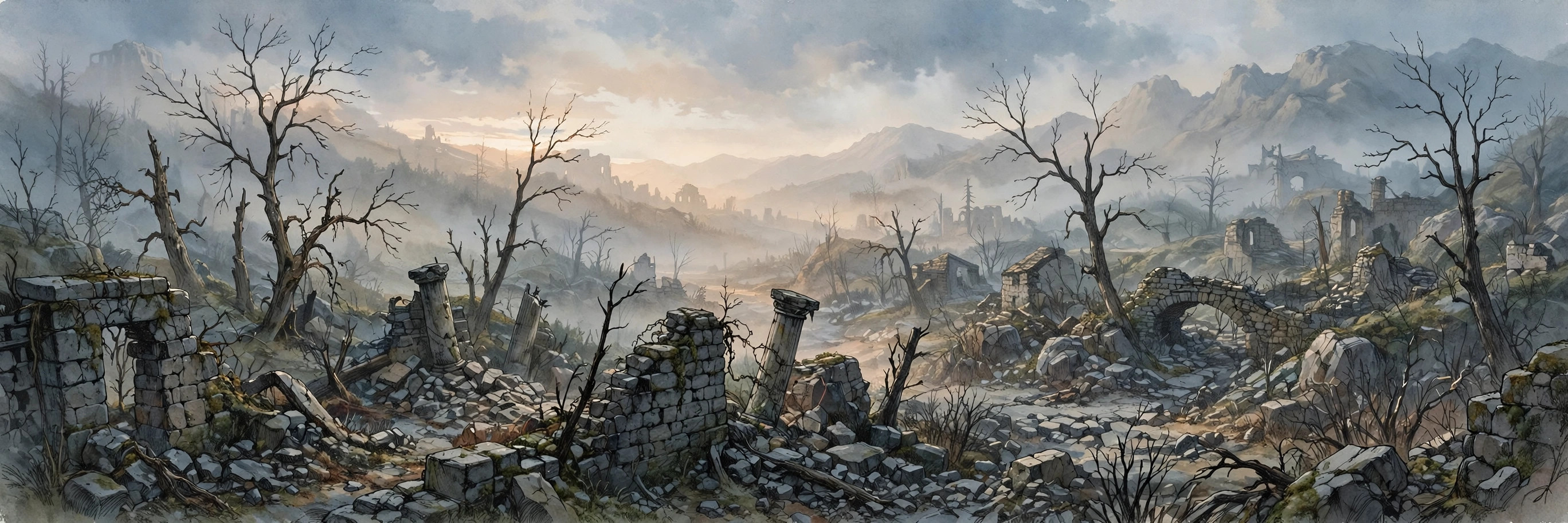
That philosophy is built, literally, around the temple itself. Ralph Fiennes returns as Doctor Kelson, the survivalist healer who has spent decades building a structure from the remains of victims of the rage virus. On paper that sounds grotesque, and in places it is. On screen, as DaCosta shoots it, it becomes something stranger and more moving: a monument, a workplace, a confession, a question made out of bone. The film is patient enough to let us understand both why Kelson built it and what building it has done to him. That patience is the film's great virtue. It does not rush to explain the temple as a symbol. It lets you sit inside its shadow for a while and feel the weight of it first.
Fiennes, and the courage to be quiet
Fiennes was already great in the first film. In the second, he is doing something I think is genuinely award-worthy, and I do not use that phrase lightly for horror. Kelson is a man who has spent decades alone with a single private project, and the film understands that solitude has a cost as well as a purpose. There is a scene in the third act, just Fiennes alone in front of the camera for about three minutes, that is one of the best pieces of acting of the year. No effects, no co-stars, just an old face talking. In a film built around faster, louder things, that scene should feel like a stall. Instead it feels like the centre of the whole duology finally coming into focus.
I agree that Fiennes deserves a Best Supporting Actor nomination, and I agree that the genre bias against horror at the Oscars means he probably will not get one. That gap between deserving and receiving is worth naming, because it tells you something about how horror is still treated as a lesser form even when it is doing the most serious work in mainstream cinema. DaCosta and Fiennes are asking questions about grief, ritual, and belief that most prestige dramas would be praised for asking. They are asking them inside a zombie movie, with blood on the floor and a bone temple in the background, and somehow that makes the questions sharper rather than duller.
The film's other great trick is tonal. The screenplay, still by Alex Garland, is surprisingly often funny — funnier than the first film — and that humour is not a release valve pasted onto horror. It is part of the horror. People in impossible situations do laugh, absurdly, inappropriately, desperately, and DaCosta lets them. There is a long sequence with a survivalist character I will not spoil where the dark comedy is so absurd that a packed theatre audience laughed out loud at a horror movie, and that laughter did not break the tension. It deepened it, because it reminded you that these characters are still human enough to find something funny in the middle of ruin. A film that can hold grief, faith, and dark comedy in the same scene without dropping any of them is doing something very difficult, and very rare.
Visually, too, DaCosta makes a deliberate break from Boyle, and it is the right break. Where 28 Years Later looked great because it looked rough, The Bone Temple looks like a real movie, composed for scale. The temple itself, when we finally see it in full, is one of the most striking single images I have seen in a horror film in years. It earns the title in a way that many titled locations do not. You understand why people would travel to it, fear it, worship near it, and argue about what it means. A horror icon that works as architecture, as metaphor, and as a practical place where characters actually live and work is a rare achievement.
What sags, and what might not land for you
None of this means the film is seamless. The middle does sag. Around the seventy-minute mark the film is balancing several storylines at once and the editing cannot quite hold them all in tension. You feel the runtime in that stretch, even though the film is just under two hours. A tighter cut would have helped, not because any single storyline is weak but because four good threads competing for attention can still feel like a traffic jam. It is a forgivable flaw in an ambitious film, but it is a real one, and viewers who prefer leaner horror may feel it more sharply than I did.
The faith angle is the other honest divide. The film is sincerely interested in religious and quasi-religious responses to mass trauma — in cults, in grief processing, in the long arc of mourning. If you read those threads as profound, the movie is operating at a level most horror films never reach. If you read them as pretentious, the same scenes will feel overbaked. I land on profound, but I can see the other reading clearly, and I respect it. A film that takes belief seriously enough to risk looking foolish is preferable, to me, to a film that treats belief as set dressing. DaCosta is not hedging. She is committing, and commitment always divides an audience.
Taken together, the two films now form one of the best zombie franchises ever made, and that claim is worth unpacking. 28 Days Later redefined the genre. The new duology does something almost no horror franchise has managed at this scale: it uses the rage virus as a metaphor for something different in each film, and it makes both metaphors land. Boyle was about coming of age in the apocalypse. DaCosta is about how we make peace with death. They are related but distinct, like two chapters of the same argument rather than two attempts at the same scare.
I also agree that a third film would risk diluting that achievement. Two films, one tight statement each, ending where this one ends — that is a complete piece of art. A third would need a third distinct idea of equal weight, and the pressure to manufacture one could easily turn a duology into a franchise in the worst sense. What I do want, unreservedly, is more Nia DaCosta, about anything. Her earlier horror work showed she could direct horror. Her blockbuster work showed she could survive a huge machine with her sensibilities intact. The Bone Temple shows what she can do at full strength with the right material. She is going to be one of the major American directors of the next decade, and this film is the evidence.
So see it in a theatre, on the largest screen available, with a sound system that can do justice to the visuals and to the score motif carried over from the first film. This is not a streaming watch. This is an event, and not just because the temple deserves scale. It deserves scale because the questions it asks deserve a room full of people sitting with them together, in the dark, for two hours, without pausing. The Bone Temple is audacious, weird, philosophically ambitious, and it earns its strangeness. That is rarer than a good scare, and it lasts longer too.
Verdict: 8.5/10. Better than the first. Worth the trip. The third act is a triumph.