Home / Gaming / Mario Kart World
Gaming · ReviewMario Kart World on Switch 2: The Best Mario Kart Has Ever Been
The open world is not a gimmick. It is a structural reimagining — and the strongest single argument for owning a Switch 2.
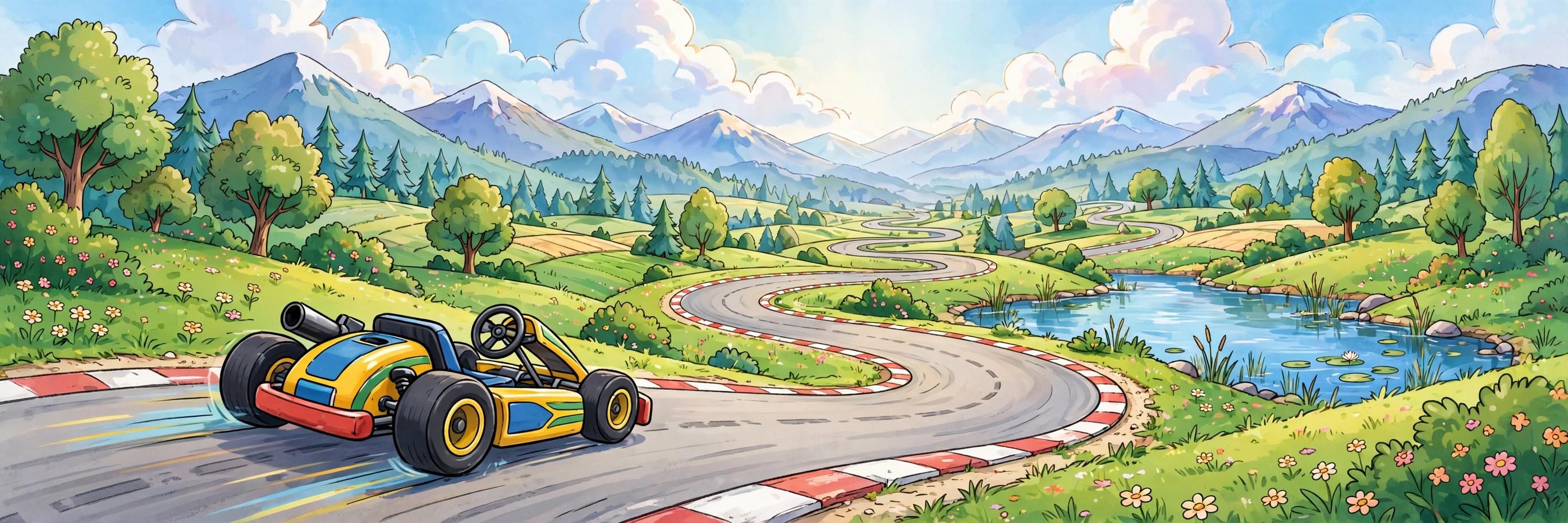
The first thing you have to unlearn about Mario Kart World is the habit of thinking in menus. For decades, Mario Kart trained us to think in discrete units: pick a cup, pick a track, race for a few minutes, watch the results screen, repeat. That rhythm was comforting because it was predictable, and it was predictable because Nintendo had refined it to the point where there was almost nothing left to refine. World breaks that rhythm on purpose, and the brave part is not that it adds an open world, but that it trusts the open world to carry the whole game without making the old game disappear inside it. The tracks are still there, still distinct, still worth learning corner by corner, but they no longer feel like isolated stages you teleport between. They feel like places, and that single change rewires how you remember a race, because you remember the journey to the track almost as vividly as the track itself.
That is why the early hours feel strange in a good way. You boot the game expecting a racing game and instead you get a place to hang around in, and hanging around turns out to be half the pleasure. Driving between events without a loading screen does something subtle to your patience: you stop treating the time between races as dead time and start treating it as part of the race. A shortcut you notice while free-roaming becomes a line you try under pressure. A landmark you drove past idly becomes a reference point when you are fighting for position. The game is teaching you its geography the way a good city teaches you its streets, not through a tutorial lecture but through repetition, curiosity, and the occasional wrong turn that still feels worth taking.
Why Knockout Changes the Stakes
Knockout mode deserves the praise it gets, because it solves a problem Mario Kart has always had: the feeling that a race can be effectively over long before the finish line. In a normal race, one bad item, one missed drift, or one perfectly timed blue shell can end your evening, and the rest of the race becomes a lonely drive for pride. Knockout changes the psychology completely, because survival becomes the objective and every segment becomes a fresh test of nerve. You are not just racing the people ahead of you; you are racing the cut line behind you, and that creates a different kind of tension, sharper and more social, because everyone in the room knows exactly when the axe is about to fall. The final stretch, with only a handful of racers left, feels less like a Mario Kart race and more like the last lap of something you actually care about.
There is also a loud, unglamorous truth here: Knockout is the mode that will keep friend groups coming back long after the novelty of the open world fades. Free-roam is delightful, but delight alone does not sustain a competitive game. What sustains it is a format that produces stories you retell afterwards, and Knockout produces those stories constantly. Someone survives by half a kart length. Someone gets eliminated on a track they normally dominate. Someone who never wins a Grand Prix suddenly becomes terrifying in a survival format because they are calm under pressure. That is the kind of mode that turns a game from a launch title into a household fixture, and it is why Knockout is a potential killer feature rather than just a nice extra.
The vehicle customization point matters for the same reason, even though it sounds smaller. Mario Kart has always flattered the idea that your kart is an expression of how you race, but older games often made that expression feel cosmetic, a choice you made once and then forgot. World makes the tradeoffs tangible enough that you can feel them in your hands, especially if, like me, you are the kind of player who misses corners and needs acceleration to recover. A build that forgives your mistakes is not a lesser build; it is a smarter one, because it lets you race your actual race instead of the perfect race you wish you drove. When a game lets you admit your weaknesses and build around them, it stops being a test of reflexes alone and becomes a test of self-knowledge, which is a much more interesting game to play for years.
The Open World Is the Argument
Free-roam is easy to dismiss as filler until you actually spend an evening doing nothing in it, and that is precisely why it works. Spending hours just driving around is not an embarrassment; it is the review. A racing game that is enjoyable when you are not racing has understood something important about play, which is that players do not always want a goal, a timer, or a ranking. Sometimes they want a world that rewards wandering, a collectible tucked behind a familiar landmark, a mini-objective that appears just as boredom might have set in, a fortress or a farm that exists simply because the world is more interesting with it in it. That is not depth in the Zelda sense, and it does not need to be. It needs to be enough to make the map feel lived-in, and it is.
The technical praise also deserves to be taken seriously, not as hardware fan talk but as design talk. Running a continuous world with many vehicles on screen, without loading screens between regions, is not just a pretty trick; it is what makes the central idea believable. If the world stuttered, or broke apart every time you crossed a border, the illusion of a connected Mario universe would collapse and the game would feel like a menu with extra steps. That it holds together is what allows you to stop thinking about the technology and start thinking about the racing, and that is the highest compliment you can pay to engineering in a Nintendo game. Style has always been Nintendo's answer to raw power, and here style and engineering meet in the middle: a painterly world that looks intentional rather than compromised, where snow, lava, and water read instantly as Mario places rather than as failed attempts at realism.
None of this erases the two complaints, and I will not let them slide. Losing characters hurts precisely because Mario Kart rosters are personal. You do not just pick a character; you main one, you defend one, you have history with one, and being told that history is paused for technical reasons feels like a broken promise even when the reasoning is understandable. The promise of future additions softens the blow but does not remove it, because a launch roster is a statement about what the game is on day one. Online matchmaking is the more serious long-term worry, because a game built around shared, chaotic, large-field racing lives or dies on whether you can reliably get into a good lobby with strangers. A brilliant single-player and couch game can survive rough online for a while, but a game that wants to be played for eight years cannot treat online as an afterthought.
The Bigger Bet Nintendo Made
What makes World important beyond its score is the restraint in its ambition. The easy version of an open-world Mario Kart would have thrown away the tracks, chased a different genre, and called the result innovation. Nintendo did the harder thing: it kept the thing people loved and built a world around it, trusting that familiarity and novelty could reinforce each other instead of competing. That is a conservative-looking choice that is actually radical, because most big publishers, faced with a thirty-year-old formula, either freeze it in place or smash it apart. Nintendo found a third path, expanding the frame without losing the picture inside it, and that is why the game feels both new and unmistakably Mario Kart at the same time.
That is also why the buy recommendation lands. If you already own the system, the question is not really whether World is good; it is whether you want the definitive version of a series you already like, and the answer, on the strength of the world, the Knockout mode, and the sheer amount of couch time it will absorb, is yes. If you do not own the system yet, World is the game that justifies the purchase not because it is the only good game on the machine, but because it is the one most likely to be played by everyone in the house, including people who would never touch a sprawling single-player epic. Some games absorb individuals for hundreds of hours. This one absorbs rooms, and rooms are what turn a console from a purchase into a habit.
So the score stands, and so does the ranking behind it. Calling World the best Mario Kart is not nostalgia-bait and it is not launch hype; it is a judgment about a design risk that paid off almost completely, with two fixable flaws attached. The roster can grow. The online can be patched. The world, the structure, and the new way of thinking about what a Mario Kart race even is cannot be patched in later, because they are the foundation. Nintendo rebuilt the foundation without knocking the house down, and that is why, years from now, this will likely be remembered not just as a great launch game but as the moment Mario Kart stopped being a collection of tracks and became a place.
Verdict: 9.0/10. The best Mario Kart, finally. Buy it.